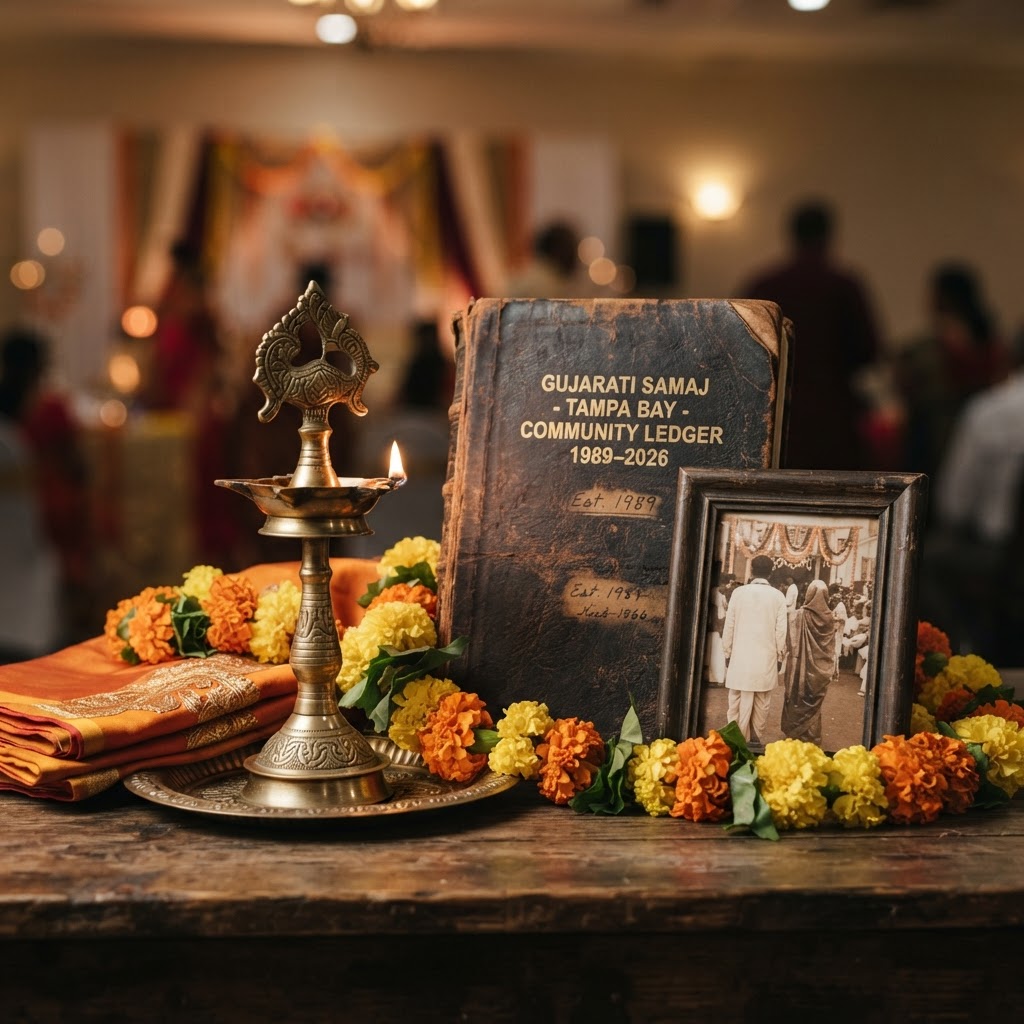
37 Years of Unity: How the Gujarati Samaj Built Tampa Bay's Biggest Indian Festival
A Festival That Started Small
The India Festival Tampa didn't start as a 10,000-person event. It started, like most community institutions do, with a small group of people who missed home. In the late 1980s, the Gujarati Samaj of Tampa Bay — a community organization founded by families who had settled in the region — began holding a gathering to mark the festivals they'd grown up with in Gujarat. The first India Festival was a few hundred people, a handful of food stalls, and a stage that was more idea than production. Nobody running it would have told you they were building a three-decade institution. They were just trying to keep a culture alive for their kids.
Thirty-seven years later, the Florida State Fairgrounds fills with about ten thousand people for one Saturday in October. There are dozens of exhibitor booths, a juried dance competition, a food section that draws people from across the state, and a volunteer base that runs the whole thing. The festival is now one of the largest Indian cultural events in the southeastern United States. The throughline from that first small gathering to today is the same organization, the same community, and the same purpose: unity with devotion.
The Gujarati Samaj: The Organization Behind It
To understand the festival, you have to understand who runs it. The Gujarati Samaj of Tampa Bay is a community organization — not a company, not a promoter, not a city agency. It's a membership-based nonprofit made up of Gujarati families in the Tampa Bay area, governed by a board, and powered by volunteers. Its purpose is to preserve and share Gujarati and broader Indian culture in the region, and the India Festival is its flagship event of the year.
That structure matters because it explains why the festival feels the way it does. There's no corporate bottom line driving the programming. The decisions about what's on stage, what's in the booths, and what the festival prioritizes are made by a community board accountable to the community. When the festival donates back to local causes, when it keeps ticket prices at $11.50, when it opens the gates to everyone regardless of background — that's the Samaj's values showing up in the event, not a marketing strategy.
How It Grew: A Decade-by-Decade Arc
The growth wasn't overnight, and it wasn't linear. In the early years, the festival moved between venues as it outgrew them — community halls, school auditoriums, then larger fairground spaces. Each move was a bet that the community would keep showing up, and each time, it did.
The dance competition grew from informal performances into a juried contest with divisions and a scoring rubric, because the community wanted it taken seriously. The marketplace grew from a few tables into a bazaar of categorized booths, because vendors from across the state wanted in. The food section grew from a couple of stalls into a regional food tour, because the cooks in the community kept bringing their best. Every expansion was a response to what the community asked for, not a plan imposed from the top.
By the 2010s, the festival had become a regional draw — people driving from Orlando, Jacksonville, even South Florida for the day. The diaspora had grown, Tampa Bay had grown, and the festival had grown with both. Today, the audience is a mix: Indian-American families who've been coming for a generation, recent arrivals, USF students, Tampa locals of every background, and visitors who plan their October around it.
The Volunteer Engine
None of it works without the volunteers, and this is the part of the story that's hardest to see from the outside. A 10,000-person, full-day event at the Florida State Fairgrounds is run, in large part, by unpaid members of the Gujarati Samaj and the broader community. They run the gates and the information booths, manage the stage schedule, coordinate the vendors, direct parking, and handle the hundred small crises that a live event generates.
A lot of those volunteers are the same parents whose kids are competing on stage. They'll be checking tickets in the morning and watching their daughter's Raas performance in the afternoon. That's not a coincidence — it's the point. The festival is the community putting on its own event, for itself, and then opening the doors. That's why it has the energy it has. It's a temple-fundraiser scaled up, not a corporate festival scaled down.
Unity With Devotion: The Theme That Holds It Together
The festival's theme — "Unity with Devotion" — isn't a slogan. It's a description of what the event actually does. The unity is the gathering: the diaspora in one place, the broader Tampa Bay community invited in, the divisions of age and background set aside for a day. The devotion is the cultural root: the dance forms that began as worship, the food tied to festival rituals, the clothing and jewelry that carry meaning, the volunteers who give their time because the culture is theirs to keep.
That theme is why the festival has lasted 37 years. Trends in event programming come and go. A community organization with a clear purpose, a volunteer base, and a culture it's devoted to preserving doesn't have to chase trends. It just keeps showing up, one Saturday a year, and the community keeps showing up with it.
What 37 Years Actually Builds
There's a thing that happens at the festival that you can only see if you've been going for a while. A kid who competed in the Minors division ten years ago is now leading a college Raas team. A volunteer who used to run the information booth has a daughter running it now. A vendor who sold sarees out of one booth in 2010 has a whole row. The festival isn't just an event — it's a timeline of a community growing up in public.
That's the real return on 37 years. The India Festival Tampa isn't valuable because it's big. It's big because it's valuable — to the people who built it, the people who keep it running, and the people who keep coming back. The next generation is already on stage. The one after that is in the audience eating a dosa. The festival's job is to make sure the tradition is there for them when it's their turn.
The Next Chapter
The 37th India Festival Tampa in 2026 is, in a sense, just the latest version of the same small gathering that started it all — bigger, louder, more polished, but built on the same foundation. The Gujarati Samaj of Tampa Bay will run it. The volunteers will show up. The dancers will have rehearsed for months. The food vendors will cook like it's the biggest day of their year. And about ten thousand people will spend a Saturday at the Florida State Fairgrounds understanding why one community organization, devoted to its culture, has been worth keeping alive for 37 years.
If you've never been, this is a good year to start. If you've been coming for years, you already know. Either way, the doors open at 9 AM on October 31, and the community will be there.