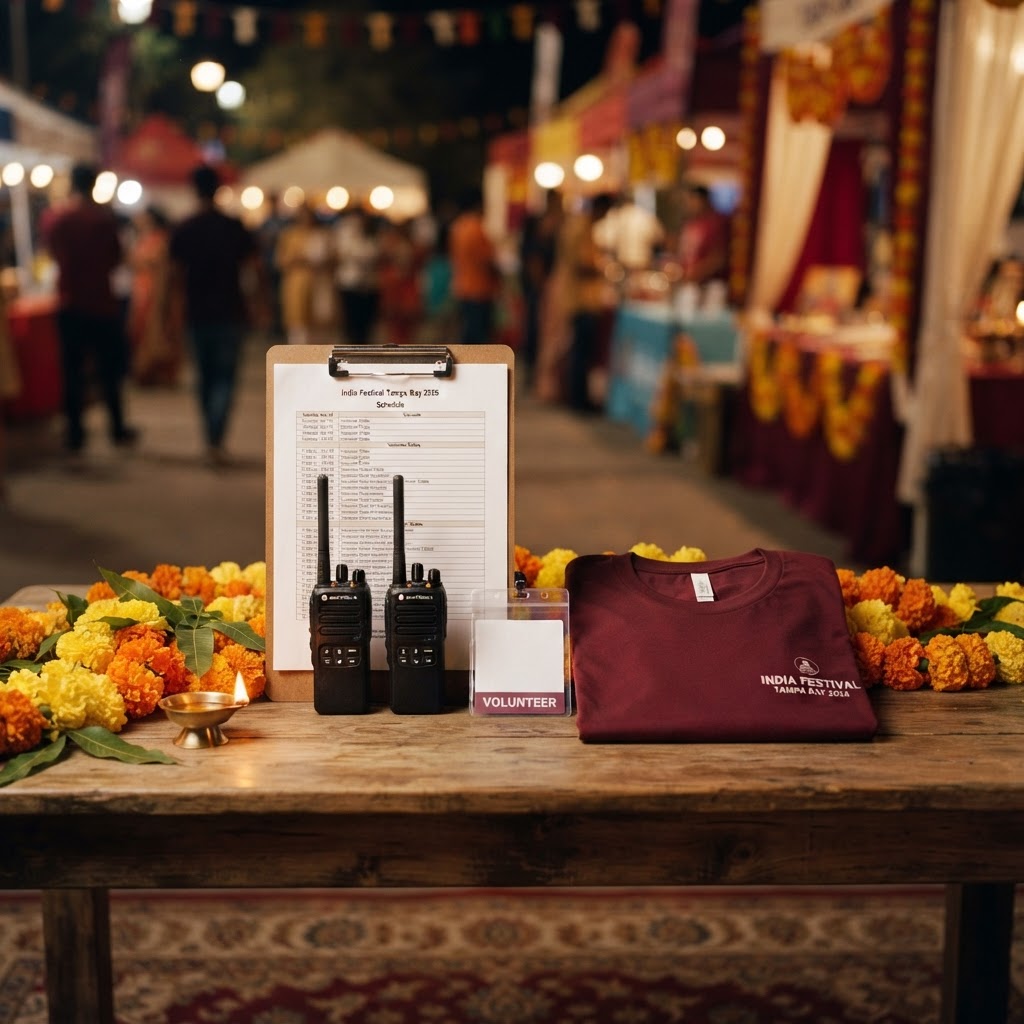
Behind the Curtain: The Volunteers Who Run India Festival Tampa
The Festival You See and the Festival You Don't
What you see when you walk into the India Festival Tampa is the finished product: the stage running on time, the booths organized, the food lines moving, the parking somehow working. What you don't see is the months of planning and the hundreds of volunteers who make a 10,000-person, full-day event at the Florida State Fairgrounds run like something smaller. The India Festival is one of the largest Indian cultural events in the southeastern United States, and it's run, in large part, by unpaid volunteers from the Gujarati Samaj of Tampa Bay and the broader community.
This is the story behind the stage. It's worth telling because the volunteer engine is the festival's real competitive advantage — the reason it feels like a community event and not a corporate one, and the reason it's been able to run for 37 years without losing its character.
The Planning Starts Long Before October
The festival runs for one Saturday in October, but the work begins months earlier. The Gujarati Samaj's festival committee starts meeting in the spring to lock the date, book the fairgrounds, and map out the year's changes. Vendor applications open months ahead — for exhibitors, food vendors, and sponsors — and a volunteer team reviews each one, assigns booths, and manages the waitlist. The dance competition has its own track: applications, team numbers, song uploads, waivers, and a scheduling process that places dozens of teams across five divisions into a running order that has to fit a single day.
By late summer, the work shifts to logistics: stage and sound production, tent and booth layout, parking and traffic flow, signage, permits, health-department coordination for the food vendors, and the thousand small operational decisions that determine whether a live event feels smooth or chaotic. None of it is glamorous. All of it is done by people who have day jobs.
The Volunteer Roles on Festival Day
On the day itself, the volunteer operation is the thing that makes the festival legible to a first-time visitor. Here's what's actually happening around you:
The gate and ticketing team runs the entrances, handles will-call and online ticket scans, and keeps the lines moving through the morning rush. This is the first face of the festival most people see, and it sets the tone.
The information and wayfinding volunteers staff the help booths and roam the floor, answering the question everyone has first: "Where's the dosa?" They keep the event navigable for the thousands of first-timers who show up every year.
The stage and competition team manages the running order of the dance competition — calling teams, coordinating the judges, keeping the schedule on time across five divisions in a single day. It's live-event production with a community accent.
The vendor and marketplace coordinators manage the exhibitor bazaar: booth assignments, load-in and load-out, power and spacing, and the small disputes that come with dozens of vendors in one hall.
The parking and traffic team does the unglamorous, essential work of moving thousands of cars in and out of the fairgrounds without gridlock. If you got in and out without a headache, thank them.
The setup and teardown crews are the first ones there and the last ones to leave. They build the stage, lay the signage, set up the booths, and then take it all down at the end of a 13-hour day.
The Parents on Stage and at the Gate
Here's the part that tells you the most about the festival: a lot of the volunteers are the same parents whose kids are competing. A mother might be scanning tickets at the gate in the morning and watching her daughter's Raas performance in the afternoon. A father might be directing parking until his shift ends, then sprinting to the stage to catch his son's Bhangra team. That overlap isn't a scheduling accident — it's the point. The festival is the community putting on its own event, and the people running it have a personal stake in it going well.
That's why the festival feels different from a commercial event. The person checking your ticket isn't a contractor who'll be at a different event next week. It's a member of the community, often the parent of a performer, who'll be back next year and the year after. The investment is personal, and you can feel it.
Why the Volunteer Model Works (and Why It's Hard)
The volunteer model has real advantages. It keeps costs down, which is part of why tickets stay at $11.50. It keeps the programming accountable to the community rather than to sponsors. And it builds a deep bench of institutional knowledge — people who've run the gate for five years know things a hired crew wouldn't.
It also has real costs. Recruiting enough volunteers for a 13-hour, 10,000-person event is a year-round effort. Coordinating them — shifts, training, communication, the inevitable no-shows — is its own management job. And the people who lead it, the committee chairs and the volunteer coordinators, carry a load that would be a full-time job if it were paid. The festival works because enough people in the community decide, every year, that it's worth their Saturday.
How to Be Part of It
If you've ever thought about volunteering, the India Festival is one of the most rewarding ways to do it in Tampa Bay. A few things to know:
- You don't have to be Gujarati, or Indian, to volunteer. The festival is a community event open to everyone, and the volunteer base reflects that. If you want to help, there's a role for you.
- Shifts are structured. You're not signing up for 13 hours. Most volunteers do a defined shift — a few hours at the gate, or the information booth, or parking — and then get to enjoy the festival.
- You'll see the festival from the inside. Volunteering is the best way to understand how a 10,000-person event actually runs, and to meet the people who make it happen.
- It matters. The festival literally cannot run without its volunteers. Every person who signs up is the reason the gates open on time.
The People Behind the Stage
When the last trophy is handed out and the lights come down on the main stage, the volunteers are still there — tearing down the booths, coiling cable, stacking chairs, and loading out the signage. By the time the fairgrounds is empty, they've put in a day that started before the first visitor arrived and ends long after the last one left. They'll be tired, and they'll be back next year.
That's the real India Festival Tampa. Not the stage, not the food, not the marketplace — the people who decide, one Saturday a year, that their community is worth their time. If you're at the festival this October, and a volunteer in a lanyard helps you find the dosa line or points you to the stage, take a second to thank them. They're the reason any of it works.