From Garba to Bhangra: The Dance Divisions That Make India Festival Tampa a Real Competition
Not a Recital. A Competition.
The first thing to understand about the dance stage at the India Festival Tampa is that it's not a showcase. It's a competition. Teams rehearse for months, the judges use a point rubric, and the trophie prizes are given during the day this is visible all across in family photos :). For the diaspora kids growing up in Tampa Bay, making a team here is a real achievement — and winning one is something they'll carry with them.
That competitive spine is what turns a cultural festival into something you can't stop watching. You don't have to know Indian dance to get pulled in. You start noticing what the judges notice — the precision of a hand gesture, the snap of a group turning in unison, the moment a performer's face changes to match the song — and by the afternoon rounds, you're leaning forward like everyone else.
The Divisions: So Everyone Competes Fairly
The competition is split into five divisions by age, so a seven-year-old's first solo isn't judged against a college team's polished Raas. The divisions are:
- Minors — the youngest performers, often a child's first time on a stage this big.
- Juniors — where you start to see real choreography and rehearsal discipline.
- High School — the most competitive youth division; high school teams treat this like a season.
- College — the showpiece division, where fusion teams and Raas teams bring months of practice and often a national-level polish.
- Adults — experienced performers, including classical soloists and community groups.
Each division has its own awards, which means the trophy table at the end of the day recognizes everyone from a kid in their first costume to a college team that's been practicing since June. That structure is why the audience stays all day — there's always a division you care about coming up next.
The Dance Forms: A Map of India on One Stage
Within the divisions, the dance forms span the country. This is where the festival does something genuinely rare: in a single day, on one stage, you can see the regional breadth of Indian dance without leaving your seat.
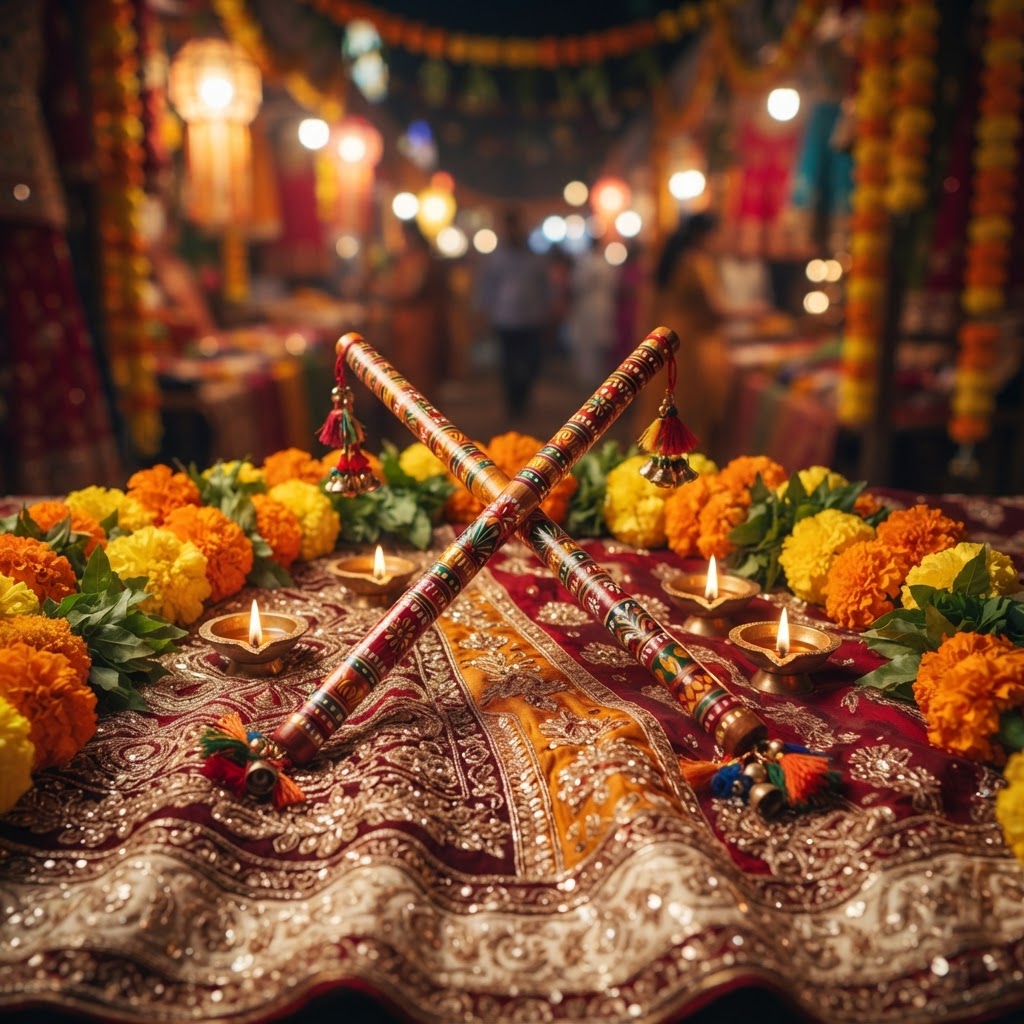
Raas and Garba come from Gujarat — the festival's cultural home base. Raas is a stick-and-circle dance (the dandiya sticks you'll hear clicking), choreographed for groups with intricate partner-passing patterns. Garba is a circular dance, traditionally devotional, that at the festival becomes a graceful group performance. Both are the heart of the Gujarati Samaj's festival, and the college Raas teams are some of the best in the southeast.
Bhangra comes from Punjab — high-energy, athletic, driven by the dhol drum, with shoulder-shimmying steps and formations that fill a stage. A good Bhangra team is impossible to ignore; you'll feel the bass before you see them.
Bharatanatyam and Kathak are the classical traditions. Bharatanatyam, from Tamil Nadu, is precise and devotional — every fingertip is a vocabulary, every glance is choreographed. Kathak, from North India, is all footwork, spins and storytelling. These are the forms where you'll see soloists who've trained for years, and they're the quiet center of the competition.
Odissi, folk pieces from Rajasthan and Maharashtra, and contemporary fusion round out the field. Fusion is where you'll see the most experimentation — classical movement set to film music, or Garba steps reimagined to a modern track. It's the division that tells you where the next generation is taking the tradition.
How It's Judged: The 500-Point Rubric
The scoring is what makes the competition legitimate. Judges score across categories that add up to a 500-point maximum, and the categories tell you what the festival actually values:
- Entry and Exit (50 points combined) — how a team commands the stage coming in and leaving. It sounds small, but it sets the tone and the judges watch it closely.
- Originality (50) — choreography that isn't just the standard patterns. Innovation scores here.
- Expression (50) — the facial and emotional performance, especially important in classical and storytelling forms.
- Coordination and Synchronization (50) — how together a group moves. In Raas and Bhangra, this is everything.
- Costume and Jewelry (50) — traditional dress is part of the form, and it's judged as craft, not decoration.
- Song Selection (50) — the music choice and how the choreography fits it.
- Choreography, Steps and Rhythm (100) — the biggest single category. This is the actual dance.
- Overall Impression (100) — the judge's holistic read of the performance.
What that rubric rewards is a complete performance: technique, expression, presentation and musicality together. A team that's technically perfect but expressionless won't beat a team that brings all of it. That's why the winners aren't always the ones with the flashiest costumes — they're the ones who put the whole package on stage.
What It Takes to Get There
What you see on stage is the last few minutes of months of work. A competitive high school or college Raas or Bhangra team will rehearse three to five days a week for two to four months before the festival. They'll choreograph, re-choreograph, drill formations, sync footwork, and rehearse in costume to test the look. There are song uploads, group photos, waivers for underage performers, and a participation fee. By the time a team walks onto the India Festival stage, they've already done the hardest part.
That investment is why the moments at the end of the day — the trophy presentations, the teams jumping on stage, the parents in the front row with phones up — feel earned. This isn't a participation ribbon. It's the end of a season.
How to Watch If You're New
If you've never seen Indian dance, the competition is one of the easiest ways in. A few tips:
- Check the schedule and pick a division. If you want energy, come for the college Raas and Bhangra rounds. If you want something quieter and more intricate, come for the classical solos.
- Watch the judges, not just the stage. You'll start to see what they're reacting to, and it teaches you what to look for.
- Stay for the finals. The top performances in each division happen in the late afternoon, and the trophy presentations are the emotional peak of the day.
- Cheer anyway. The teams feed off the audience. You don't need to know the form to appreciate a clean turn or a perfectly timed dip.
Why It Matters Beyond the Stage
The competition is the festival's engine, but it's also something more: it's how a generation of Indian-American kids in Tampa Bay stay connected to a culture their parents crossed an ocean to bring here. The kid practicing a Bharatanatyam mudra in a Carrollwood living room on a Tuesday night is doing the same gesture her grandmother learned in Chennai. The college Raas team drilling in a USF gym is keeping a Gujarati folk form alive in a country that didn't invent it.
That's the real prize. The trophies are the excuse. The tradition is the point. And on the main stage at the India Festival Tampa, one Saturday a year, you can watch it happen in real time.